
Mapping InfoDengue: Investigating New Solutions to Generate Useful Information for Management and Advances in Arbovirus Control Knowledge
The Host Study
InfoDengue is an arbovirus risk alert system that operates through integrated and timely analysis of climate and epidemiological data, selected to structure a Pathfinder study.
Launched in 2014 in partnership with Fiocruz's Scientific Computing Program (PROCC/Fiocruz) and the Getúlio Vargas Foundation's School of Applied Mathematics (FGV EMAp), the system operates at municipal, state and national levels. In addition to weekly arbovirus risk reports with predictive models for dengue and chikungunya, the research group addresses epidemiological analysis requests from the Brazilian Ministry of Health, responds to media inquiries, produces scientific articles, and organizes courses, seminars, sprints and conferences.
Home | Pathfinder matrix | Stakeholders | Timeline | Resources | Team
Pathfinder
This project was supported by the Wellcome Trust (Grant 226688/Z/22/Z).
Process mapping
A study of this scale can benefit from a process mapping methodology, since, in an international context, it enables not only documentation but also mapping and identification of areas for improvement.
Under the title "InfoDengue mapping: investigating new solutions to generate useful information for the management of, and advances in knowledge on, arbovirus control", Pathfinder aims to trace the steps and processes of the InfoDengue host study in order to determine the challenges and successes encountered in generating public health research evidence through the following objectives:
- To generate a process map of the host study to document selected steps and their associated metrics.
- To determine the tools, methods, approaches and systems applied to each step.
- To describe each challenge encountered and document how it was addressed.
- To identify new solutions to the problems mapped during the process.
- To disseminate the findings to support other studies in overcoming similar challenges and bottlenecks in their own research.
Key results
- A mind map (flow) with the study stages systematised.
- Detailed information on the tools, methods, skills and systems used, highlighting their application and effectiveness at each stage of the study.
- Analysis of challenges and adopted solutions, explaining how they helped achieve the study objectives, with an emphasis on lessons that can be shared with other similar studies.
Home | Process mapping | Stakeholders | Timeline | Resources | Team
Pathfinder matrix
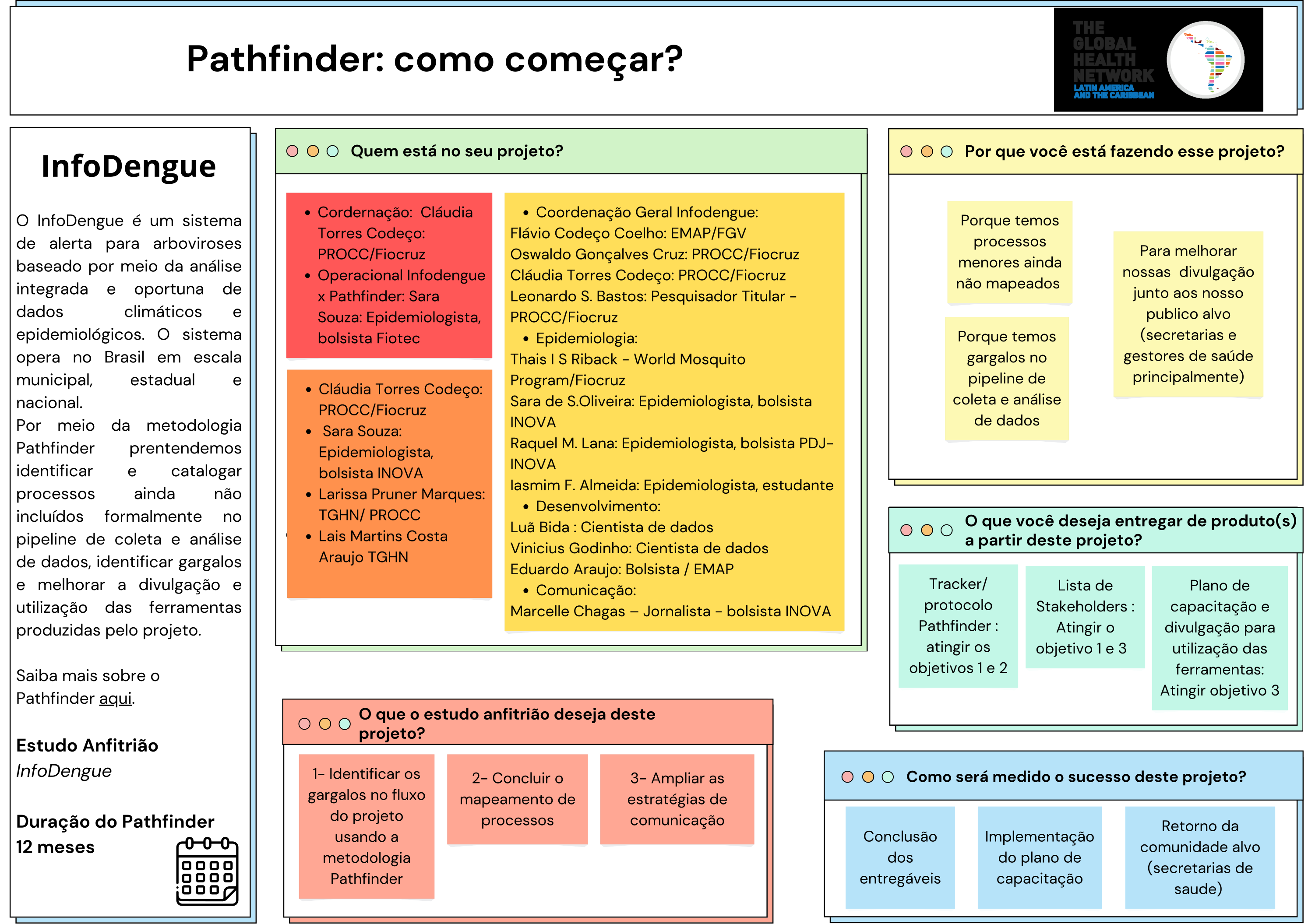
The Pathfinder matrix was built as a guide for Pathfinder Projects, to help define what the project is, its motivations, the host study’s goals and how the researcher will measure success, ensuring everyone is aligned before starting.
In the first circle, a document icon. Below: "Start: Presentation of the weekly minutes". In the second circle, a magnifying glass in front of a sheet of paper. Below: "Sequence: Summary of the epidemiological situation for dengue and chikungunya in the country, with the main highlights, as well as atypical situations and possible inconsistencies in the reports". In the last circle, an icon of a list on a document with a pen beside it. Below: "Sequence: adjustment according to weekly demands, presentation of progress on subprojects and tasks, and other important points that may arise during the week and need discussion".
Home | Process mapping | Pathfinder matrix | Timeline | Resources | Team
Stakeholder engagement
Through this mapping, stakeholder engagement was systematised. In the context of InfoDengue, stakeholders include the project team, as well as managers and focal points within state and municipal health departments, the Ministry of Health, international health agencies, other projects with similar areas of work and interests, researchers, students, communications professionals and civil society. Each stakeholder engages in different ways.
Within the internal team, engagement occurs through strengthening working relationships and supporting capacity development. With external partners, interaction happens through dissemination and use of the project’s tools, responding to requests for data and analyses, interviews and media coverage, science communication and outreach, as well as other actions to strengthen the broader field of data science applied to infectious disease monitoring.
Stakeholders – InfoDengue



2024 August - September
Planning matrix
November
- Final version of the Pathfinder protocol and tracker v.1
- Pathfinder presentation at the TGHN LAC Pathfinder Clinic
- Hybrid Learning Session: Qualitative methodology for using the Tracker
- Qualitative research to complete the tracker (document analysis)
December
- Qualitative research to complete the tracker (discussion group and interviews)
2025 January
Qualitative data analysis and tracker v.2
April
Development of the thematic glossary
June
- Policy brief
- Pathfinder testimonials
August
Presentations at the 18th Latin American Congress of Social Medicine and Public Health
October
November
- Pathfinder video (in production)
- Pathfinder testimonials (in production)
- E-Vigilância Symposium
December
- Webinar: Strengthening research capacity and collaboration in health: lessons from Pathfinder host studies in Latin America and the Caribbean
- Release of results (final report, glossary, video)
Home | Process mapping | Pathfinder matrix | Stakeholders | Timeline | Resources
Pathfinder team
The Pathfinder team is made up of InfoDengue and TGHN LAC Fiocruz researchers, an integration that enabled complementary expertise and strengthened the work carried out.