The InfoDengue Research Club brings together professionals and students interested in epidemiological surveillance, data science and public health to study the arboviral disease scenario in Brazil. The club promotes a space for exchange, learning and development of interdisciplinary solutions to strengthen the monitoring of vector-borne and climate-sensitive diseases, such as dengue, Zika and chikungunya.
Sign up and receive information about activities promoted by the Research Club and related topics from TGHN LAC.
The objective of the Club is to discuss, test and refine technologies and methods applied to arbovirus surveillance based on data organised by the InfoDengue alert system, with an emphasis on the integrated analysis of hybrid data – including climatic information and epidemiological records – to generate early risk signals and predictive models to support public health decision-making.
InfoDengue
InfoDengue has been active since 2015, covering all Brazilian municipalities since 2021. It is the result of coordination between Fiocruz, Fundação Getulio Vargas, other research institutions, the Ministry of Health and municipal and state health departments. The system’s mission is to provide qualified, near real-time information on the risk of arbovirus transmission, supporting local and national surveillance. It is also part of TGHN LAC through the InfoDengue Pathfinder Project, which aims to trace the steps and processes of the InfoDengue host study to identify the challenges and successes encountered in generating health research evidence.
The InfoDengue system integrates multiple data sources – such as official case notifications and climatic variables (temperature, humidity) – to monitor risk factors and detect early signs of sustained transmission. It uses advanced statistical methods, such as Bayesian models and estimates of the effective reproductive number (Rt), which allow weekly classification of alert levels by municipality: green (unfavourable conditions for transmission), yellow (favourable conditions), orange (sustained transmission) and red (high incidence). In partnership with the Mosqlimate project, predictive models of case incidence are also produced.
Schedule
Between January and July 2025, 16 meetings were held, with an average of 15 to 16 participants.
Meeting flow
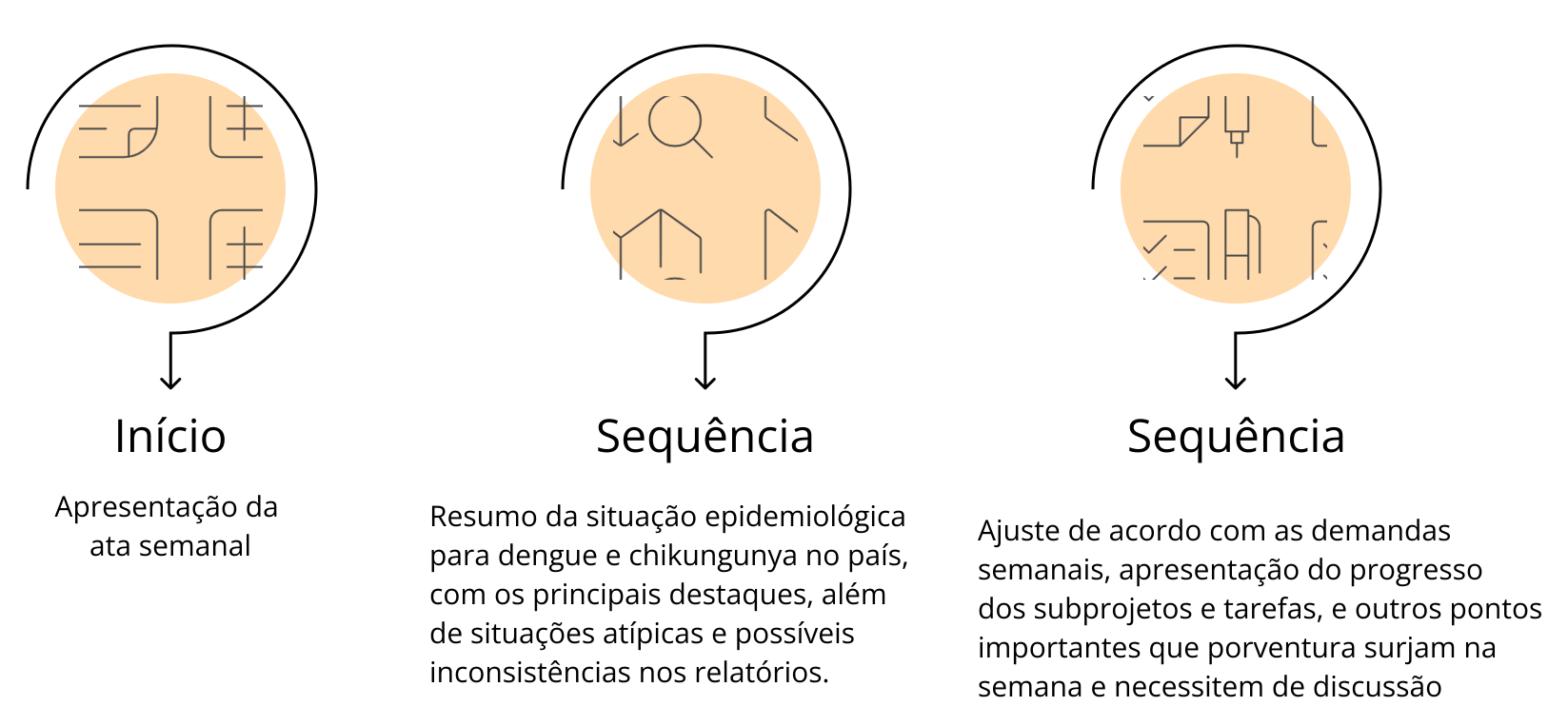
In the first circle, a document icon. Below it: "Start: Presentation of the weekly minutes." In the second circle, an icon with a magnifying glass in front of a sheet of paper. Below it: "Sequence: Summary of the epidemiological situation for dengue and chikungunya in the country, with the main highlights, as well as atypical situations and possible inconsistencies in the reports." In the last circle, an icon with a list on a document and a pen beside it. Below it: "Sequence: adjustment according to weekly demands, presentation of the progress of subprojects and tasks, and other important points that may arise during the week and require discussion."
These meetings have led to comments and articles published such as “The expansion of chikungunya in Brazil” in The Lancet, and subprojects such as Submunicipal InfoDengue and work with laboratory data from the Gerenciador de Ambiente Laboratorial (GAL) for the whole country.
Activities and events
E-Vigilância 2025 is a symposium that aims to bring together and strengthen a community of researchers, students, professionals and entrepreneurs from different sectors who are interested in technologies for health surveillance.
Webinar Preparing for the 2026 dengue season: perspectives from predictive models
The event presented the results of the 2nd InfoDengue–Mosqlimate Challenge Sprint and the forecasts for dengue in 2026 in Brazil, based on predictive models that strengthen public health surveillance. Led by the InfoDengue and Mosqlimate teams, the initiative brought together data scientists to jointly develop and train models (ensemble models).
Webinar 2nd InfoDengue–Mosqlimate Dengue Challenge (IMDC) - Results and forecasts for 2026
Researchers Flavio Codeço Coelho, Eduardo Araújo and Fabiana Ganem, from Fundação Getulio Vargas (FGV), presented the innovative approach of the 2nd InfoDengue–Mosqlimate Dengue Challenge, which aims to strengthen the accuracy of forecasts and thereby more effectively support decision-making by the Ministry of Health in Brazil.
Webinar Preparing for the 2025 dengue season: perspectives from predictive models
The webinar discussed the methodology, dengue forecasts for 2025 and how to integrate these models into decision-making for mosquito-borne diseases. In “Preparing for the 2025 dengue season: perspectives from predictive models”, we shared the knowledge gained from this experience and discussed how we can apply these methods in other countries. With presentations by Claudia Codeço (Fiocruz/Brazil), Rachel Lowe (Barcelona Supercomputing Center/Spain), Flávio Coelho (Fundação Getulio Vargas/Brazil) and Marcela Santos (Ministry of Health/Brazil), and organisation by Fiocruz, FGV and TGHN LAC.
Resources