
Mapping InfoGripe: new solutions to generate useful information for management and to advance knowledge on severe acute respiratory syndromes (SARS)
The host study

The InfoGripe project began in 2014 with the aim of monitoring and disseminating data on cases of Severe Acute Respiratory Syndromes (SARS) in Brazil, including influenza and other respiratory diseases.
Based on data obtained from the Influenza Epidemiological Surveillance Information System (SIVEP-Gripe) of the Brazilian Ministry of Health, InfoGripe produces weekly forecasts and analyses on the behaviour of these syndromes, identifying trends of increase or decrease in cases across different regions of the country using statistical models. During the COVID-19 pandemic, the project became an essential tool for monitoring the evolution of the disease and guiding public health policies. Over the years, InfoGripe has contributed to improving epidemiological surveillance in Brazil, providing crucial information for decision-making in public health and the prevention of outbreaks.
The processes and results generated by InfoGripe over the years have been fundamental in supporting health managers and civil society, providing information on the impact of respiratory diseases in the country. In addition to its importance for public health in Brazil, the selection of the project to be part of Pathfinder is justified by the need to identify and map processes of dialogue with health managers and the press, as well as to foster engagement with international organisations.
Pathfinder
This project was supported by the Wellcome Trust (Grant 226688/Z/22/Z).
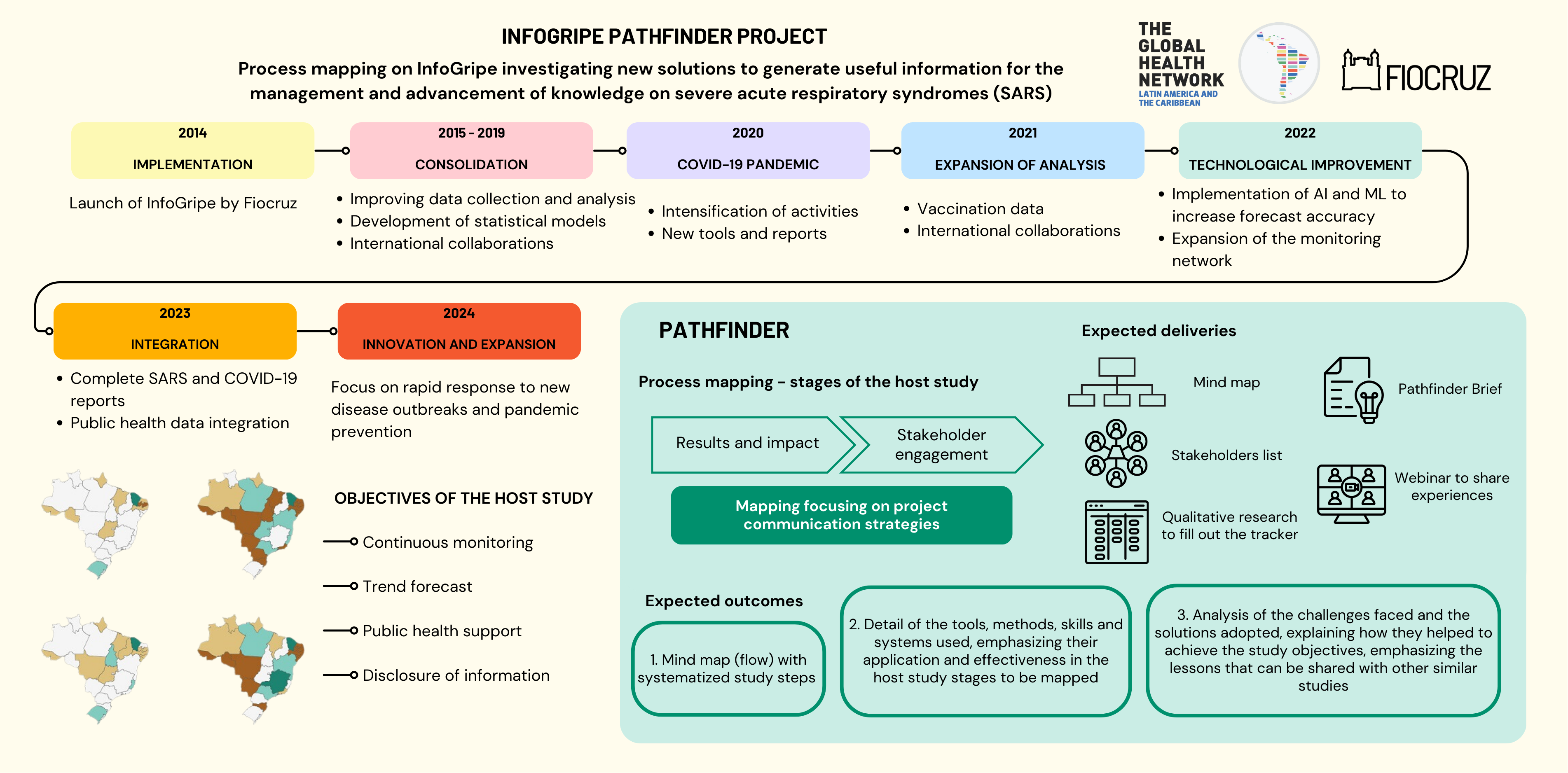
Process mapping
The Pathfinder study "Mapping InfoGripe: new solutions to generate useful information for management and the advancement of knowledge on severe acute respiratory syndromes (SARS)" was proposed to address these needs by identifying the actors involved and interested in the project (stakeholders) and their impact on participation, as well as systematising the communication carried out by the host study.
The aim is to generate data, information and indicators on the reach of InfoGripe in society, with its partners, and to identify possible adjustments to the outputs delivered weekly by the project in order to expand this reach and impact.
The mapping of processes within InfoGripe will be carried out using the Tracker tool provided by TGHN. The categories mapped using the Tracker will be Results and Impact and Stakeholder Engagement.
Objectives:
Mapping of the InfoGripe host study.
Identify the tools, methods, approaches and systems used across the study stages.
Identify the challenges, solutions and lessons learnt from the key stages of the host study to share with similar studies.
Key results:
A mind map (flow) with systematised study stages.
Details of the tools, methods, skills and systems used, highlighting their application and effectiveness across the mapped stages of the host study.
Analysis of challenges and solutions adopted, explaining how they contributed to achieving the study objectives, highlighting lessons that can be shared with other similar studies.
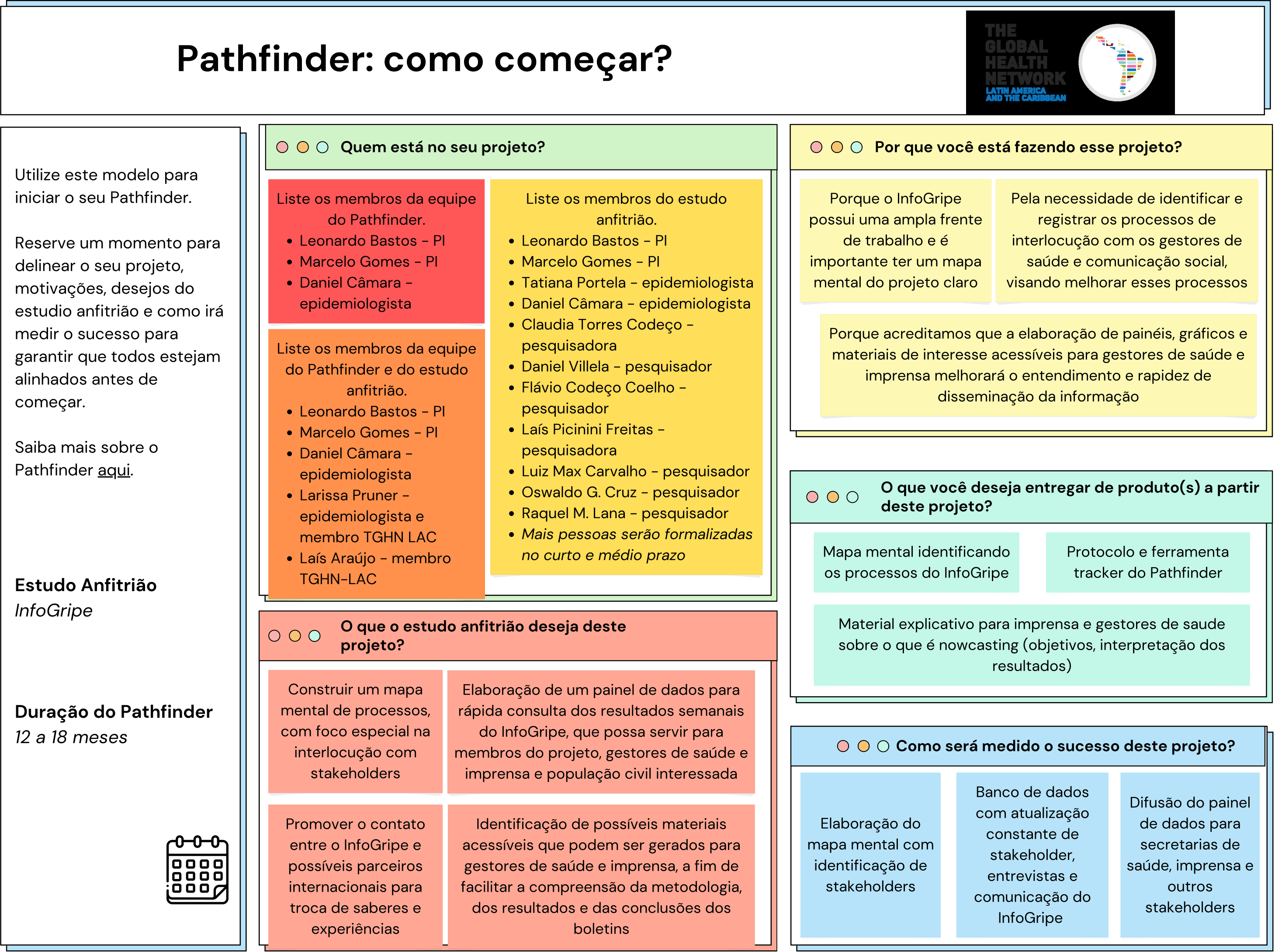
Pathfinder Matrix
The Pathfinder matrix was developed as a guide for Pathfinder Projects to help define what the project is, its motivations, the host study’s objectives, and how success will be measured, ensuring that everyone is aligned before starting.
In the first circle, a document icon. Below, “Start: Presentation of the weekly minutes”. In the second circle, an icon with a magnifying glass over a document. Below, “Sequence: Summary of the epidemiological situation for dengue and chikungunya in the country, including key highlights, atypical situations and possible inconsistencies in reports”. In the last circle, an icon with a list on a document and a pen. Below, “Sequence: adjustments according to weekly demands, presentation of progress on subprojects and tasks, and other important issues that may arise during the week and require discussion”.
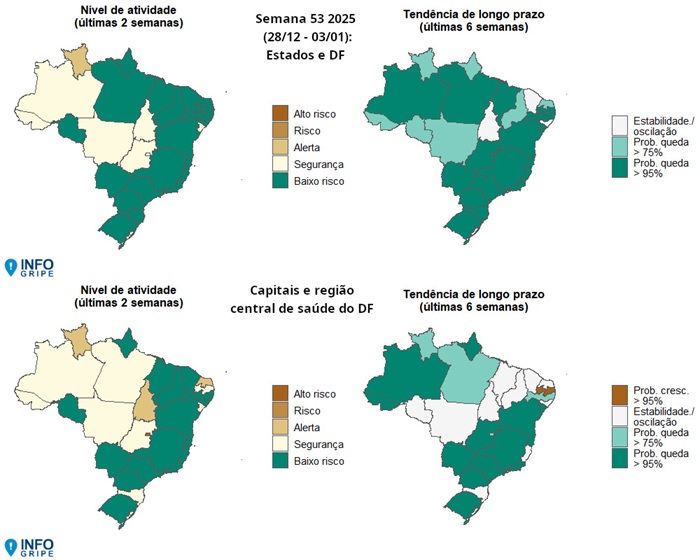
Weekly analysis panel
The InfoGripe Bulletin is a strategy of the Unified Health System (SUS) aimed at monitoring cases of Severe Acute Respiratory Syndromes (SARS) in the country. The initiative supports health surveillance systems in identifying priority areas for action, preparedness and response to public health events.
August – September 2024
Outputs and events:
- Mind map
- Planning matrix
- Pathfinder Workshop: how to get started?
November
- Final version of the Pathfinder protocol and tracker v.1 (document analysis)
- Presentation of InfoDengue and InfoGripe at the TGHN LAC Pathfinder Clinic
- Hybrid Learning Session: Qualitative methodology for tracker use
- Conducting qualitative research for the tracker (document analysis)
December
Conducting qualitative research for the tracker (discussion group and interviews)
January – February 2025
Qualitative data analysis and tracker v.2
March
InfoGripe: monitoring severe acute respiratory infections in Brazil – Global Health Data Science working group, presentation by Daniel Cardoso Portela Camara (Fiocruz; Brazil)
April
Presentation of progress of the InfoGripe and InfoDengue Pathfinders at the TGHN LAC Pathfinder Clinic Session
June
Preparation of the stakeholder list and team ORCIDs
July
Development of the first version of the Final Report
October
Final report v.1
November
Outputs and events:
- Thematic glossary
- Pathfinder video
- Pathfinder testimonials
- E-Vigilância Symposium
December
- Webinar Building capacity and colaboration in health research: lessons from Pathfinder studies in Latin America and the Caribbean
- Launch of results (final report, glossary, video)
Pathfinder resources and events

Pathfinder Team
The Pathfinder team is composed of researchers from InfoGripe and TGHN LAC Fiocruz, an integration that enabled complementary expertise and strengthened the work developed.