arrow-downarrow-rightarrow-upback-arrowchecklistcloseAsset 5cpd-clockcpd-competenciescpd-cv-buildcpd-keyAsset 3cpd-other-pointscpd-previous-skillscpd-question-markreject2cpd-skillscpd-step-completecpd-submitcpd-updated-skillsddpm-closeddpm-starenvelopefacebookfilesglobegraphlinkedinmembermenunode-triangle-borderlessnode-trianglepluspm-clinicalpm-cmcpm-collapsepm-deliverypm-downloadpm-expandpm-global-accesspm-infopm-partnerspm-regulatorypm-researchpm-strategyrounded-arrow-rightArtboard 1speech-bubblesstarstar2triangletwitteryoutube
We use cookies to track visits to our website, and we don't store any of your personal details. Find out more
The Global Health Network The Global Health Network WHO Collaborating Centre
www.tghn.org

Not a member?

Find out what The Global Health Network can do for you. Register now.

More
Less
Donate Now

Member Sites A network of members around the world. Join now.

  • 1000 Challenge
  • ODIN Wastewater Surveillance Project
  • CEPI Technical Resources
  • UK Overseas Territories Public Health Network
  • MIRNA
  • Global Malaria Research
  • Global Snakebite Research
  • Global Outbreaks Research
  • Vivli Knowledge Hub
  • Sub-Saharan Congenital Anomalies Network
  • Global Health Data Science
  • Africa CDC
  • AI for Global Health Research
  • MRC Clinical Trials Unit at UCL
  • ARCH
  • IHR-SP
  • Virtual Biorepository
  • CONNECT
  • Rapid Support Team
  • The Global Health Network Africa
  • The Global Health Network Asia
  • The Global Health Network LAC
  • The Global Health Network MENA
  • Global Health Bioethics
  • Global Pandemic Planning
  • ACROSS
  • EPIDEMIC ETHICS
  • Global Vector Hub
  • PANDORA
  • Global Health Economics
  • LactaHub – Breastfeeding Knowledge
  • Global Birth Defects
  • Fiocruz
  • Antimicrobial Resistance (AMR)
  • EDCTP Knowledge Hub
  • PediCAP
  • CHAIN Network
  • ALERRT
  • Brain Infections Global
  • Research Capacity Network
  • Global Research Nurses
  • mesh
  • ZIKAlliance
  • ZikaPLAN
  • TDR Knowledge Hub
  • Global Health Coordinators
  • Global Health Laboratories
  • Global Health Methodology Research
  • Global Health Social Science
  • Global Health Trials
  • Zika Infection
  • Mother Child Health
  • Global Musculoskeletal
  • Global Pharmacovigilance
  • Global Pregnancy CoLab
  • INTERGROWTH-21ˢᵗ
  • ISARIC
  • WEPHREN
  • East African Consortium for Clinical Research
  • WANETAM
  • CANTAM
  • TESA
  • GBS
  • Women in Global Health Research
  • HeLTI
  • Global Health Research Management
  • Coronavirus

Research Tools Resources designed to help you.

  • Site Finder
  • Process Map
  • Global Health Training Centre
  • Resources Gateway
  • Global Health Research Process Map
The Global Health Network LAC
  • Inicio
    • Acerca de
    • Mapa regional
    • Contacto
    • Noticias
  • Actividades y eventos
    • Clubs de Investigación
    • Clínica de datos
    • Sesiones de Aprendizaje Asistido
    • Mentoría
    • Talleres
    • Webinarios
    • Twinning
    • Otras Actividades
  • Recursos
    • Crear un Club de Investigación
    • Preparar Sesiones de Aprendizaje Asistido
    • Crear Data Clinic
    • Búsqueda de información en bases … alertas PubMed
  • eLearning
  • Desarrollo profesional
  • Proyectos Pathfinder
    • Pathfinder Argentina
    • Pathfinders Brasil
    • Pathfinder Colombia
    • Pathfinder Honduras
    • Pathfinder Perú
    • Pathfinder Republica Dominicana
  • Mapa Interactivo
  • LAC Foro
  • Impacto
TGHN LAC Logo banner. - LAC

Reflexiones sobre las enfermedades infecciosas con riesgo de recrudecimiento y sus factores desencadenantes

TGHN LAC Logo banner. LAC
  • Acerca de
  • Mapa regional
  • Contacto
  • Noticias

Reflexiones sobre las enfermedades infecciosas con riesgo de recrudecimiento y sus factores desencadenantes

Según un importante estudio internacional dirigido por The Global Health Network y comisionado por Wellcome, enfermedades infecciosas como la malaria, el dengue y la tuberculosis suponen un reto tan grande para la salud mundial como los patógenos nuevos o emergentes. Publicada en Nature Scientific Reports, la investigación recopiló las opiniones de 3752 profesionales de la salud e investigadores de 151 países y es uno de los estudios globales más amplios de este tipo, con un 86.9% de los participantes procedentes de países de ingresos bajos y medios. Los participantes señalaron que el cambio climático, la pobreza y la resistencia a los medicamentos se combinan para crear una crisis sanitaria cada vez mayor que podría convertirse en una «catástrofe progresiva» si no se aborda.

A continuación, compartimos algunas reflexiones sobre el estudio, según los comentarios de colaboradores internacionales.

Dra. Aliya Naheed, directora del Centro NIHR GHR para las Enfermedades No Transmisibles y el Cambio Ambiental de Bangladesh, afirmó: «Este fenomenal estudio se hace eco de la disparidad fundamental que existe entre las principales prioridades sanitarias de los países de ingresos bajos y medios (PIBM) y los países de ingresos altos, reconociendo el papel del cambio climático en las futuras emergencias sanitarias. El mensaje sobre la amenaza futura que suponen las cargas de morbilidad conocidas pone de relieve la necesidad de una inversión mundial equitativa en la prevención y el control de las enfermedades infecciosas comunes en los PIBM».

Dra. Josie Golding, directora de Epidemias y Epidemiología, Enfermedades Infecciosas, de Wellcome, afirmó: «El cambio climático está impulsando la propagación de enfermedades infecciosas y está afectando con mayor dureza a las comunidades menos capaces de adaptarse. El aumento de las temperaturas, las inundaciones y las sequías crean las condiciones ideales para la proliferación de mosquitos, garrapatas y bacterias nocivas, mientras que las condiciones meteorológicas extremas añaden presión a unos sistemas sanitarios ya de por sí frágiles. Necesitamos una acción climática global urgente, junto con inversiones en soluciones innovadoras para prevenir y tratar las enfermedades infecciosas. Es esencial actuar en ambos frentes; sin ello, enfermedades como la malaria, el dengue y el chikunguña seguirán aumentando, lo que agravará las desigualdades y pondrá en peligro millones de vidas. Sabemos que el clima y la salud son inseparables, y que al abordar los factores comunes que provocan enfermedades, desde el cambio climático hasta la resistencia a los antimicrobianos, podemos fortalecer los sistemas de salud para hacer frente a los problemas actuales y emergentes».

Dr. Julio Canario, director de la Fundación Etikos, República Dominicana. «Este estudio, sumamente riguroso y participativo, es un llamamiento claro y unificado a la acción para la comunidad dedicada a las enfermedades infecciosas y los responsables políticos. Confirma que la mayor amenaza es una «catástrofe progresiva» impulsada por la escalada de enfermedades endémicas, más que un evento pandémico repentino. El momento en que se publican estos hallazgos es crucial, ya que sitúan directamente la reorientación de las agendas de investigación regionales y la financiación hacia estrategias de intervención transversales, en particular al destacar el papel del cambio climático y los factores socioeconómicos en las enfermedades transmitidas por vectores, el VIH y la tuberculosis».

Dra. Jackeline Alger, Instituto Antonio Vidal, Honduras: «Los resultados presentados, fruto de una metodología que garantiza una amplia representación geográfica y pragmática, constituyen una valiosa contribución a la comprensión de las amenazas mundiales que plantean las enfermedades infecciosas y los factores relacionados con ellas, incluido el impacto ecológico del cambio climático. Debemos actuar ahora con un enfoque equitativo que facilite la participación activa de aquellos sobre los que estas amenazas tienen un impacto más negativo».

Dra. Vanessa de Arruda Jorge, Oficina del Presidente, Fiocruz, Brasil: «Mediante una metodología colaborativa, este estudio proporciona pruebas fundamentales sobre cómo el cambio climático está intensificando los riesgos de enfermedades infecciosas, lo que afecta de manera desproporcionada a las regiones con recursos limitados. Subraya la urgente necesidad de que los gobiernos, las instituciones sanitarias mundiales y otros actores den prioridad a la inversión en ciencia ciudadana —en la que la investigación, la vigilancia y las estrategias de mitigación se llevan a cabo en colaboración con las comunidades—, especialmente en el Sur Global, en países como Brasil, donde estos impactos ya son evidentes. Las conclusiones coinciden en gran medida con los debates de la COP30 en Belém, lo que refuerza la necesidad imperiosa de traducir los conocimientos científicos en una acción global coordinada que garantice la equidad y la preparación frente a las amenazas sanitarias emergentes».

El estudio, Global perspectives on infectious diseases at risk of escalation and their drivers, está publicado en Nature Scientific Reports (DOI: 10.1038/s41598-025-22573-3).
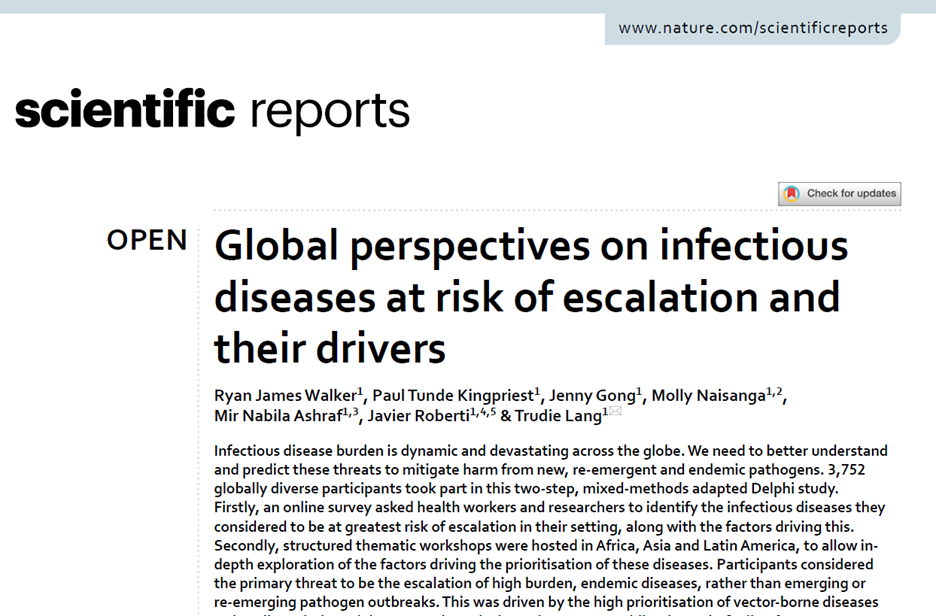
 

Global perspectives on infectious diseases at risk of escalation and their drivers, is published in Nature Scientific Reports, DOI: 10.1038/s41598-025-22573-3.

Reflections on infectious diseases at risk of resurgence and their drivers

According to a major international study led by The Global Health Network and commissioned by Wellcome, infectious diseases such as malaria, dengue, and tuberculosis pose as great a challenge to global health as new or emerging pathogens. Published in Nature Scientific Reports, the research gathered the views of 3,752 healthcare professionals and researchers from 151 countries and is one of the most extensive global studies of its kind, with 86.9% of participants coming from low- and middle-income countries. Participants noted that climate change, poverty, and antimicrobial resistance combine to create an increasingly severe health crisis that could become a “progressive catastrophe” if not addressed.

Below, we share some reflections on the study, based on comments from international collaborators.

Dr Aliya Naheed, Director of the NIHR GHR Centre for Non-Communicable Diseases and Environmental Change in Bangladesh, stated: “This phenomenal study echoes the fundamental disparity that exists between the main health priorities of low- and middle-income countries (LMICs) and high-income countries, recognising the role of climate change in future health emergencies. The message about the future threat posed by known disease burdens highlights the need for equitable global investment in the prevention and control of common infectious diseases in LMICs.”

Dr Josie Golding, Head of Epidemics and Epidemiology, Infectious Diseases, at Wellcome, stated: “Climate change is driving the spread of infectious diseases and is hitting hardest those communities least able to adapt. Rising temperatures, floods, and droughts create ideal conditions for mosquitoes, ticks, and harmful bacteria to thrive, while extreme weather adds pressure to already fragile health systems. We need urgent global climate action, alongside investments in innovative solutions to prevent and treat infectious diseases. It is essential to act on both fronts; without this, diseases such as malaria, dengue, and chikungunya will continue to increase, deepening inequalities and putting millions of lives at risk. We know that climate and health are inseparable, and by addressing common disease drivers – from climate change to antimicrobial resistance – we can strengthen health systems to tackle current and emerging challenges.”

Dr Julio Canario, Director of Fundación Etikos, Dominican Republic, noted: “This highly rigorous and participatory study is a clear and unified call to action for the infectious disease community and policymakers. It confirms that the greatest threat is a ‘progressive catastrophe’ driven by the escalation of endemic diseases rather than a sudden pandemic event. The timing of these findings is crucial, as they directly reorient regional research agendas and funding towards cross-cutting intervention strategies, particularly by highlighting the role of climate change and socioeconomic factors in vector-borne diseases, HIV, and tuberculosis.”

Dr Jackeline Alger, Instituto Antonio Vidal, Honduras, commented: “The results presented, derived from a methodology that ensures broad geographical and pragmatic representation, make a valuable contribution to understanding the global threats posed by infectious diseases and their related factors, including the ecological impact of climate change. We must act now with an equitable approach that enables the active participation of those who are most negatively affected by these threats.”

Dr Vanessa de Arruda Jorge, Office of the President, Fiocruz, Brazil, stated: “Through a collaborative methodology, this study provides essential evidence on how climate change is intensifying infectious disease risks, disproportionately affecting regions with limited resources. It underlines the urgent need for governments, global health institutions, and other actors to prioritise investment in citizen science – where research, surveillance, and mitigation strategies are carried out in collaboration with communities – especially across the Global South, in countries such as Brazil, where these impacts are already evident. The findings strongly align with COP30 discussions in Belém, reinforcing the pressing need to translate scientific knowledge into coordinated global action that ensures equity and preparedness in the face of emerging health threats.”

The study, Global perspectives on infectious diseases at risk of escalation and their drivers, is published in Nature Scientific Reports (DOI: 10.1038/s41598-025-22573-3).

Global perspectives on infectious diseases at risk of escalation and their drivers is published in Nature Scientific Reports, DOI: 10.1038/s41598-025-22573-3.

Support the community

Thank you for visiting The Global Health Network, please take a moment to read this important message. As you know, our aim is to enable equity in access to research knowledge and this is successfully delivering support and training to 1000’s of research teams all over the world. But we need your support!. If you have benefited from this research skills and knowledge sharing facility, please help us sustain this remarkable and unique provision of information for those who could otherwise not access such support and training. We would be really grateful if you could make a donation or ask your employer or organisation to contribute to the costs of maintaining this platform and the generation of new contents for all users. Just a small contribution from everyone who can afford to pay would keep this available for those who cannot. Thank you, we really appreciate your part in this community effort to better equity in global health research.

Donate Now

©Copyright 2009 - 2025, The Global Health Network LAC

  • Links
    • Contact
    • Terms & Conditions
    • Accessibility
    • Privacy Policy
The Global Health Network is a World Health Organization collaborating centre for Research Information Sharing, E-learning, and Capacity Development