Workshop Pathfinder para Estudos em Atenção Primária à Saúde
O Workshop Pathfinder para Estudos em Atenção Primária à Saúde foi uma atividade formativa organizada pela equipe Fiocruz da The Global Health Network Latin America and the Caribbean (TGHN LAC), em parceria com a Escola Nacional de Saúde Pública Sérgio Arouca (ENSP/Fiocruz), direcionada às equipes do projeto EEAPS – Estudos Estratégicos em Atenção Primária à Saúde.
O workshop teve como objetivo fortalecer capacidades no uso da metodologia Pathfinder, uma abordagem voltada ao mapeamento de processos de pesquisa, permitindo identificar desafios, propor soluções e gerar aprendizados transferíveis entre estudos. A atividade foi desenvolvida em duas sessões complementares combinando apresentação conceitual, atividade prática e discussão coletiva, com ênfase na aplicação direta das ferramentas Pathfinder ao contexto real dos estudos do EEAPS.
Objetivos
Apresentar a metodologia Pathfinder e sua aplicação nos estudos de Atenção Primária à Saúde, destacando como o mapeamento de processos pode apoiar a organização e a melhoria das pesquisas.
Apoiar o planejamento dos estudos Pathfinder por meio da utilização da Matriz de Planejamento Pathfinder, favorecendo a organização das etapas, atores e produtos dos estudos.
Aprofundar a aplicação prática do Pathfinder, com foco na operacionalização dos estudos Pathfinder por meio da ferramenta de mapeamento (Tracker Pathfinder).
Promover a troca de experiências e o aprendizado colaborativo entre os diferentes eixos do projeto EEAPS.
Estrutura e Metodologia
O workshop teve duração total de 6 horas, organizadas em dois encontros de 3 horas cada, realizados em formato online e presencial, com uma metodologia participativa que incluiu:
Apresentações teóricas breves.
Exemplos de estudos Pathfinder na América Latina e no Brasil.
Atividades práticas em grupos, organizadas por eixos temáticos do EEAPS - Acesso, Apoio Institucional, Coordenação do Cuidado e Monitoramento e Avaliação.
Discussão coletiva e sistematização dos aprendizados.
Sessões
1
Apresentação da Metodologia Pathfinder
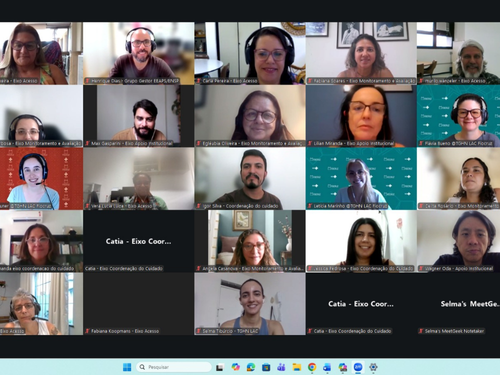
23 de março de 2026 - Online
Foco
Introdução à metodologia Pathfinder.
Discussão de desafios comuns na condução de estudos em APS.
Construção inicial da Matriz de Planejamento Pathfinder aplicada aos estudos do EEAPS.
Resultados
Compreensão compartilhada da metodologia Pathfinder.
Identificação preliminar de desafios e oportunidades de melhoria nos estudos.
Primeira versão da matriz de planejamento Pathfinder por eixo de estudo.
2
Mapeamento de Processos com o Tracker Pathfinder
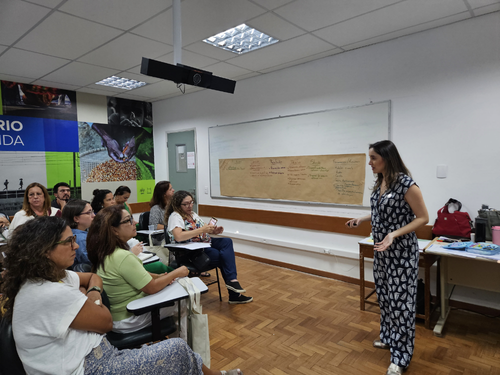
26 de março de 2026 - Presencial
Foco
Revisão das matrizes de planejamento elaboradas na primeira sessão.
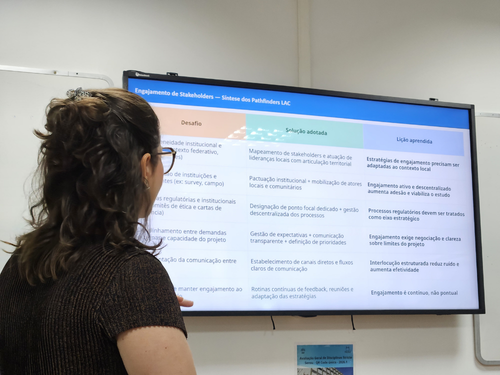
Introdução e uso prático do Tracker Pathfinder como ferramenta de mapeamento de processos.
Personalização do Tracker ao contexto de cada estudo do EEAPS.
Discussão sobre estratégias de implementação do Pathfinder e próximos passos.
Resultados
Versão refinada da matriz de planejamento Pathfinder.
Construção inicial do Tracker Pathfinder para os estudos do EEAPS.
Maior clareza sobre como implementar o Pathfinder na prática.
Perfil dos participantes e avaliação
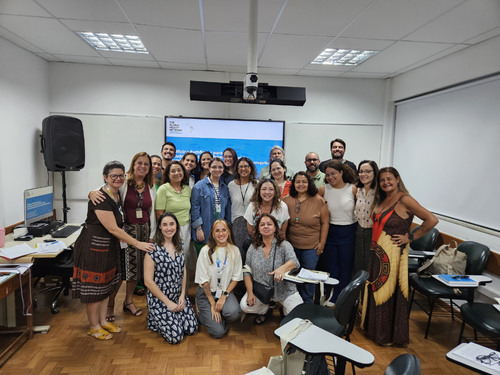
A oficina contou com a participação de 20 pessoas, sendo 16 mulheres e 4 homens, provenientes dos diferentes eixos do Projeto EEAPS. A avaliação indicou impacto positivo na formação, com destaque para:
Relato majoritário de melhoria do nível de conhecimento após a oficina.
Reconhecimento unânime de que o conhecimento adquirido foi útil e aplicável ao trabalho e/ou estudo dos participantes.
Elevado índice de satisfação, com predominância de avaliações máximas.
Interesse de parte dos participantes em desenvolver e publicar materiais relacionados aos temas abordados.
Utilidade do conhecimento no trabalho e no estudo
As respostas indicaram que o conhecimento adquirido contribuirá principalmente para:
Organização e clareza das etapas e processos de pesquisa, permitindo visualizar o estudo como um todo.
Mapeamento objetivo dos processos já realizados e daqueles ainda a serem executados.
Sistematização e registro do “making off” da pesquisa, fortalecendo a memória do processo investigativo.
Aprimoramento do planejamento e da reflexão prospectiva, apoiando ajustes nas etapas subsequentes.
Divulgação e comunicação das etapas da pesquisa e identificação de convergências entre os diferentes projetos de APS.
Comentários qualitativos dos participantes reforçaram a relevância e a aplicabilidade da metodologia Pathfinder, bem como sugestões para aprofundamento:
“O método é riquíssimo e se aplica ao desenho do nosso projeto, permitindo o resguardo da trajetória da pesquisa.”
“Gostei imensamente que os quatro projetos da APS estivessem juntos, pois visualizamos convergências e pontos de interseção.”
Resultados e próximos passos
As oficinas permitiram avançar na sistematização dos processos de pesquisa dos estudos do EEAPS, gerando subsídios para:
O aprimoramento da coordenação de estudos complexos com múltiplos atores.
O desenvolvimento de produtos compartilhados entre os eixos do projeto.
A consolidação de aprendizados institucionais transferíveis para outros contextos de pesquisa em APS.
Interesse de parte dos participantes em desenvolver e publicar materiais relacionados aos temas abordados.
Como próximos passos, foi proposto o acompanhamento das equipes interessadas em aprofundar a implementação do Pathfinder e a possibilidade de apoio específico para o mapeamento de processos.
Coordenação e facilitação
O workshop foi coordenado por Larissa Pruner Marques, PhD, e facilitado em conjunto com:
Flávia Thedim Costa Bueno, PhD
Henrique Sant'anna Dias, PhD
Letícia Carvalho de Mattos Marinho, MSc
Profissionais com experiência na aplicação da metodologia Pathfinder na América Latina, vinculados à Fiocruz e à The Global Health Network Latin America and the Caribbean (TGHN LAC).
El Taller Pathfinder para Estudios en Atención Primaria de Salud fue una actividad formativa organizada por el equipo Fiocruz de la Red de Salud Global América Latina y el Caribe (TGHN LAC), en asociación con la Escuela Nacional de Salud Pública Sergio Arouca (ENSP/Fiocruz), dirigida a los equipos del proyecto EEAPS – Estudios Estratégicos en Atención Primaria de Salud.
El taller tuvo como objetivo fortalecer capacidades en el uso de la metodología Pathfinder, un enfoque orientado al mapeo de procesos de investigación, permitiendo identificar desafíos, proponer soluciones y generar aprendizajes transferibles entre estudios. La actividad fue desarrollada en dos sesiones complementarias combinando presentación conceptual, actividad práctica y discusión colectiva, con énfasis en la aplicación directa de las herramientas Pathfinder al contexto real de los estudios del EEAPS.
Objetivos
Presentar la metodología Pathfinder y su aplicación en los estudios de Atención Primaria de Salud, destacando cómo el mapeo de procesos puede apoyar la organización y la mejora de las investigaciones.
Apoyar la planificación de los estudios Pathfinder por medio de la utilización de la Matriz de Planificación Pathfinder, favoreciendo la organización de las etapas, actores y productos de los estudios.
Profundizar la aplicación práctica del Pathfinder, con foco en la operacionalización de los estudios Pathfinder por medio de la herramienta de mapeo (Tracker Pathfinder).
Promover el intercambio de experiencias y el aprendizaje colaborativo entre los diferentes ejes del proyecto EEAPS.
Estructura y Metodología
El taller tuvo una duración total de 6 horas, organizadas en dos encuentros de 3 horas cada uno, realizados en formato online y presencial, con una metodología participativa que incluyó:
Presentaciones teóricas breves.
Ejemplos de estudios Pathfinder en América Latina y en Brasil.
Actividades prácticas en grupos, organizadas por ejes temáticos del EEAPS - Acceso, Apoyo Institucional, Coordinación del Cuidado y Monitoreo y Evaluación.
Discusión colectiva y sistematización de los aprendizajes.
Sesiones
1
Presentación de la Metodología Pathfinder
23 de marzo de 2026 - En línea
Enfoque
Introducción a la metodología Pathfinder.
Discusión de desafíos comunes en la conducción de estudios en APS.
Construcción inicial de la Matriz de Planificación Pathfinder aplicada a los estudios del EEAPS.
Resultados Esperados
Comprensión compartida de la metodología Pathfinder.
Identificación preliminar de desafíos y oportunidades de mejora en los estudios.
Primera versión de la matriz de planificación Pathfinder por eje de estudio.
2
Mapeo de Procesos con el Tracker Pathfinder
26 de marzo de 2026 - Presencial
Enfoque
Revisión de las matrices de planificación elaboradas en la primera sesión.
Introducción y uso práctico del Tracker Pathfinder como herramienta de mapeo de procesos.
Personalización del Tracker al contexto de cada estudio del EEAPS.
Discusión sobre estrategias de implementación del Pathfinder y próximos pasos.
Resultados Esperados
Versión refinada de la matriz de planificación Pathfinder.
Construcción inicial del Tracker Pathfinder para los estudios del EEAPS.
Mayor claridad sobre cómo implementar el Pathfinder en la práctica.
Participant Profile and Evaluation
The workshop was attended by 20 people, comprising 16 women and 4 men, from the different axes of the EEAPS Project. The evaluation indicated a positive impact on training, with emphasis on:
Majority report of improved knowledge levels following the workshop.
Unanimous recognition that the knowledge acquired was useful and applicable to the work and/or study of the participants.
High satisfaction index, with predominance of maximum evaluations.
Interest amongst some participants in developing and publishing materials related to the topics covered.
Usefulness of Knowledge in Work and Study
The responses indicated that the knowledge acquired would mainly contribute to:
Organisation and clarity of research stages and processes, allowing visualisation of the study as a whole.
Objective mapping of processes already undertaken and those still to be executed.
Systematisation and documentation of the research "behind-the-scenes", strengthening the memory of the investigative process.
Improved planning and prospective reflection, supporting adjustments in subsequent stages.
Dissemination and communication of research stages and identification of convergences amongst the different primary healthcare projects.
Qualitative comments from participants reinforced the relevance and applicability of the Pathfinder methodology, as well as suggestions for deeper engagement:
"The method is very rich and applies to the design of our project, allowing preservation of the research trajectory."
"I was very pleased that the four primary healthcare projects were together, as we could see convergences and points of intersection."
Outcomes and Next Steps
The workshops enabled progress in the systematisation of research processes of the EEAPS studies, generating inputs for:
The improvement of coordination of complex studies with multiple actors.
The development of shared products amongst the project axes.
The consolidation of institutional learning transferable to other primary healthcare research contexts.
Interest amongst some participants in developing and publishing materials related to the topics covered.
As next steps, it was proposed to provide support to teams interested in deepening Pathfinder implementation and the possibility of specific assistance for process mapping.
Coordinación y facilitación
El taller fue coordinado por Larissa Pruner Marques, PhD, y facilitado en conjunto con:
Flávia Thedim Costa Bueno, PhD
Henrique Sant'anna Dias, PhD
Letícia Carvalho de Mattos Marinho, MSc
Profesionales con experiencia en la aplicación de la metodología Pathfinder en América Latina, vinculados a Fiocruz y a la Red de Salud Global América Latina y el Caribe (TGHN LAC).
The Pathfinder Workshop for Studies in Primary Healthcare was a training activity organised by the Fiocruz team at The Global Health Network Latin America and the Caribbean (TGHN LAC), in partnership with the Sergio Arouca National School of Public Health (ENSP/Fiocruz), directed towards the teams of the EEAPS project – Strategic Studies in Primary Healthcare.
The workshop aimed to strengthen capacities in the use of the Pathfinder methodology, an approach focused on mapping research processes, allowing the identification of challenges, proposal of solutions and generation of transferable learning between studies. The activity was developed in two complementary sessions combining conceptual presentation, practical activity and collective discussion, with emphasis on the direct application of Pathfinder tools to the real context of the EEAPS studies.
Objectives
To present the Pathfinder methodology and its application in studies of Primary Healthcare, highlighting how process mapping can support the organisation and improvement of research.
To support the planning of Pathfinder studies through the use of the Pathfinder Planning Matrix, favouring the organisation of stages, actors and products of the studies.
To deepen the practical application of Pathfinder, with a focus on operationalising Pathfinder studies through the mapping tool (Pathfinder Tracker).
To promote the exchange of experiences and collaborative learning amongst the different axes of the EEAPS project.
Structure and Methodology
The workshop had a total duration of 6 hours, organised in two 3-hour meetings, conducted in online and in-person format, with a participatory methodology that included:
Brief theoretical presentations.
Examples of Pathfinder studies in Latin America and Brazil.
Practical group activities, organised by EEAPS thematic axes - Access, Institutional Support, Care Coordination and Monitoring and Evaluation.
Collective discussion and systematisation of learning.
Sessions
1
Presentation of the Pathfinder Methodology
23 March 2026 - Online
Focus
Introduction to the Pathfinder methodology.
Discussion of common challenges in conducting studies in primary healthcare.
Initial construction of the Pathfinder Planning Matrix applied to EEAPS studies.
Expected Outcomes
Shared understanding of the Pathfinder methodology.
Preliminary identification of challenges and opportunities for improvement in the studies.
First version of the Pathfinder planning matrix per study axis.
2
Process Mapping with the Pathfinder Tracker
26 March 2026 - In-person
Focus
Review of planning matrices developed in the first session.
Introduction and practical use of the Pathfinder Tracker as a process mapping tool.
Customisation of the Tracker to the context of each EEAPS study.
Discussion on Pathfinder implementation strategies and next steps.
Expected Outcomes
Refined version of the Pathfinder planning matrix.
Initial construction of the Pathfinder Tracker for EEAPS studies.
Greater clarity on how to implement Pathfinder in practice.
Participant Profile and Evaluation
The workshop was attended by 20 people, comprising 16 women and 4 men, from the different axes of the EEAPS Project. The evaluation indicated a positive impact on training, with emphasis on:
Majority report of improved knowledge levels following the workshop.
Unanimous recognition that the knowledge acquired was useful and applicable to the work and/or study of the participants.
High satisfaction index, with predominance of maximum evaluations.
Interest amongst some participants in developing and publishing materials related to the topics covered.
Usefulness of Knowledge in Work and Study
The responses indicated that the knowledge acquired would mainly contribute to:
Organisation and clarity of research stages and processes, allowing visualisation of the study as a whole.
Objective mapping of processes already undertaken and those still to be executed.
Systematisation and documentation of the research "behind-the-scenes", strengthening the memory of the investigative process.
Improved planning and prospective reflection, supporting adjustments in subsequent stages.
Dissemination and communication of research stages and identification of convergences amongst the different primary healthcare projects.
Qualitative comments from participants reinforced the relevance and applicability of the Pathfinder methodology, as well as suggestions for deeper engagement:
"The method is very rich and applies to the design of our project, allowing preservation of the research trajectory."
"I was very pleased that the four primary healthcare projects were together, as we could see convergences and points of intersection."
Outcomes and Next Steps
The workshops enabled progress in the systematisation of research processes of the EEAPS studies, generating inputs for:
The improvement of coordination of complex studies with multiple actors.
The development of shared products amongst the project axes.
The consolidation of institutional learning transferable to other primary healthcare research contexts.
Interest amongst some participants in developing and publishing materials related to the topics covered.
As next steps, it was proposed to provide support to teams interested in deepening Pathfinder implementation and the possibility of specific assistance for process mapping.
Coordination and Facilitation
The workshop was coordinated by Larissa Pruner Marques, PhD, and facilitated jointly with:
Flávia Thedim Costa Bueno, PhD
Henrique Sant'anna Dias, PhD
Letícia Carvalho de Mattos Marinho, MSc
Professionals with experience in the application of the Pathfinder methodology in Latin America, linked to Fiocruz and The Global Health Network Latin America and the Caribbean (TGHN LAC).